

You’ve been here months and never been bitten? That’s not luck. That’s Brunswick County Mosquito Control.
Most newcomers have no idea it exists — but there’s a year-round operation keeping mosquitoes down across our coast. Here’s how it works:
There’s no separate mosquito board. It’s the Vector Control Division inside Brunswick County Operation Services (910-253-2515, mosquitocontrol@brunswickcountync.gov). They monitor 47 mosquito species across 35 treatment zones, all year long.
Many of our beach towns run their own programs — a state survey counted 13 Brunswick County municipalities doing some form of mosquito control. Everywhere else, including Calabash — which appears on the county’s own spray-zone list — the county covers you. (One honesty note: I couldn’t verify a complete, current town-by-town roster from a single county source, so if you’re inside a town limit and unsure, check with your town hall.)
The playbook, in order:
- Surveillance — trapping and counting mosquitoes, tracking species and population size year-round
- Larviciding — treating breeding areas before mosquitoes mature, with products like Natular (based on spinosad, a naturally occurring soil organism) and BVA-2, a biodegradable oil film that suffocates larvae and pupae
- Truck spraying — Biomist 3+15 from sprayers equipped with Smart Flow Technology, triggered when landing counts hit 7 mosquitoes per minute
- Water management — ditch and drainage work to eliminate breeding habitat at the source
- Aerial spraying — after hurricanes and major floods, when broods explode (the state spent $4 million on post-Florence mosquito control across 27 counties, Brunswick included)
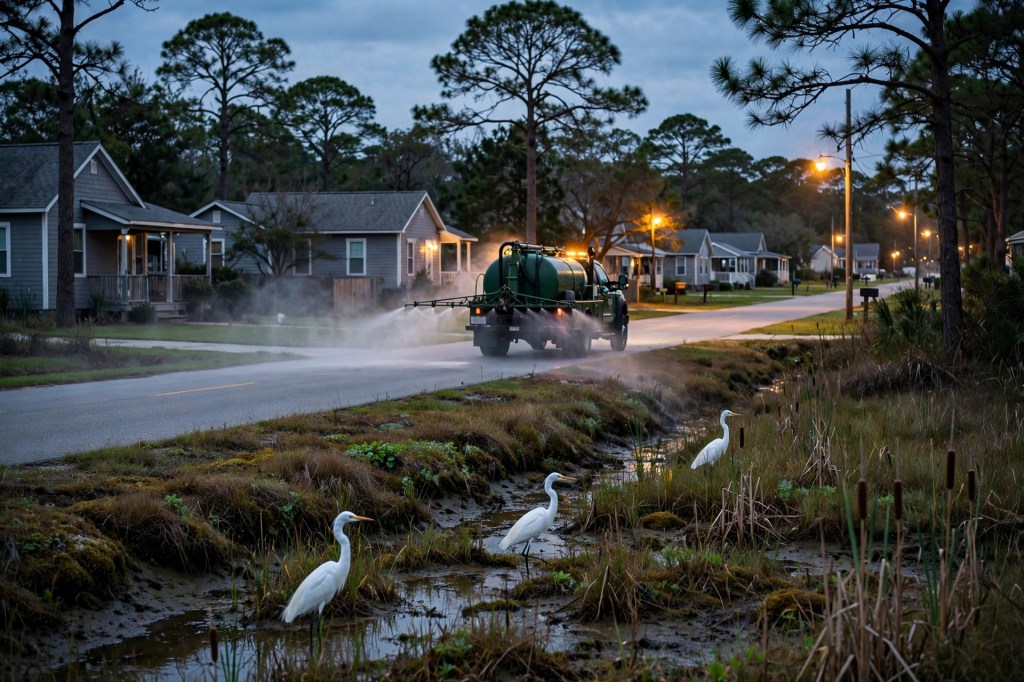
You can even request service — the county takes spray requests from residents (it logged more than 9,000 requests in 2018 alone).
Why it matters beyond itchy ankles: West Nile virus turned up in a Brunswick County resident in 2021, and Eastern equine encephalitis was found in horses here this year. About a third of people who develop EEE don’t survive. The mosquitoes are here. The diseases are here. A big reason you’re not getting bitten is this program — though no program eliminates every mosquito.
What does it cost? The county doesn’t publish a standalone mosquito-control line item — it’s funded through the Operation Services budget (about $10.7 million for FY 2026-27, covering everything from building maintenance to mosquito control), plus federal and state grants, including a U.S. Army Corps of Engineers contract running 2026-2030 and FEMA reimbursements after storms.
Do your part: tip and toss anything holding water. Even a small amount of standing water left for about a week can breed mosquitoes — health officials advise emptying water-holding items at least weekly.


Leave a Reply