
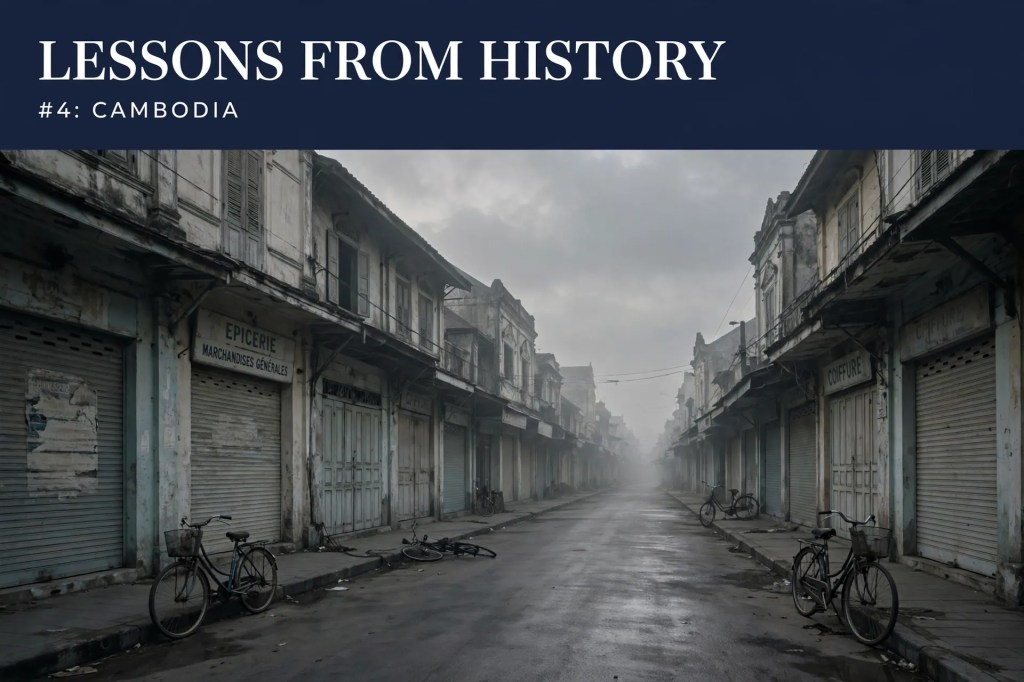
“Lessons From History” #4: Cambodia
THE SHORT VERSION: In 1975, Cambodia’s communists emptied the cities and tried to build a perfect agrarian society from Year Zero. In under four years, roughly a quarter of the country’s people were dead — starved, worked to death, or executed.
NOW THE FULL STORY:
When the Khmer Rouge, led by Pol Pot, took Phnom Penh on April 17, 1975, they did not celebrate in the capital — they emptied it. Within days, millions of city residents were marched into the countryside at gunpoint, told it was temporary. It was not. Money, schools, hospitals, temples, and private property were abolished. The regime called it Year Zero: history would start over, and Cambodia would be remade as a nation of peasants.
Everyone was put to work in the fields, often for 12 hours or more a day, on starvation rations. People who wore glasses, spoke a foreign language, or had been teachers, doctors, or officials were suspect — the regime treated education itself as evidence of disloyalty. Suspects were taken to prisons like Tuol Sleng, known as S-21, where thousands were tortured into confessions and then trucked to the killing fields outside the city.
The death toll is commonly estimated at roughly 1.7 to 2 million people between 1975 and 1979 — from execution, starvation, disease, and overwork. That was about a quarter of Cambodia’s population, wiped out by its own government in less than four years. The regime fell only when Vietnam invaded in early 1979 and drove the Khmer Rouge from power.
THE LESSON: Plymouth starved a colony. The Soviet Union starved nations. Mao starved tens of millions. Cambodia shows what happens when the idea is taken to its logical end, with no brakes at all: a government that decides an entire class of people — city dwellers, the educated, anyone who remembers the old world — must simply disappear. The warning is not that communism fails slowly. It is that, given total power, it can fail catastrophically fast.
Tomorrow: the two Germanys — the same people, the same language, divided by a wall, with two very different results.
#LessonsFromHistory #CarolinaAfterDeadline


Leave a Reply