
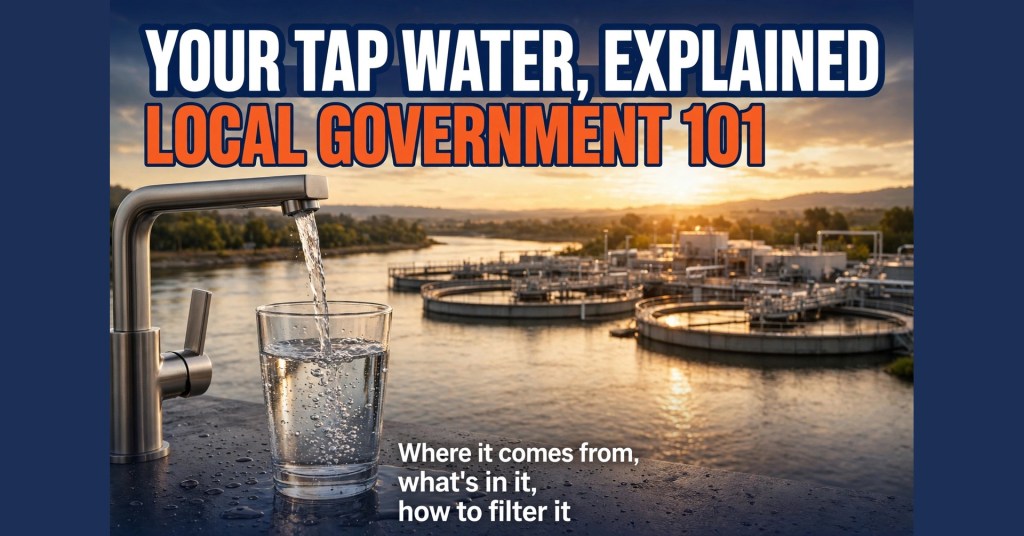
💧 LOCAL GOVERNMENT 101: Where your water comes from — and what’s actually in it.
Here’s the short version: if you live in Calabash, Carolina Shores, Sunset Beach, Shallotte, or Ocean Isle Beach, your tap water comes from the Cape Fear River, treated by Brunswick County. Right now, two “forever chemicals” — PFOA and PFOS — are showing up in finished water above the EPA’s legal limit. The county is finishing a $167 million reverse-osmosis upgrade, the largest of its kind on the East Coast, expected online by the end of this year and designed to strip those chemicals out. Until then, a standard Brita pitcher won’t do the job — but a certified filter will. Full details below. 👇
WHO SELLS YOU THE WATER
None of our five towns runs its own water system. Calabash, Carolina Shores, Sunset Beach, and Shallotte are all direct retail customers of Brunswick County Public Utilities — about 63,600 customers countywide. Ocean Isle Beach buys water wholesale from the county and handles its own pipes and billing (same arrangement as Oak Island and Holden Beach). Either way, the water in the tap is the same county-treated water everywhere around here.
WHERE IT COMES FROM
About 80% comes from the Cape Fear River, drawn above Lock & Dam #1 in Bladen County. The other 20% is groundwater from 14 wells drilled roughly 175 feet into the Castle Hayne Aquifer along the Highway 211 corridor, treated at a separate smaller plant near Southport. Here’s the part that matters for us: Calabash, Carolina Shores, Sunset Beach, Shallotte, and Ocean Isle Beach all get their water solely from the big Northwest plant — meaning 100% Cape Fear River water. (Southport, St. James, Oak Island, and Caswell Beach get a blend that includes the groundwater.)
HOW IT’S TREATED — AND THE $167 MILLION FIX
Today the river water gets conventional treatment: filtration and disinfection with chlorine and chloramines. That handles sediment and germs just fine. What it does NOT remove: PFAS — the “forever chemicals,” including GenX — and the industrial solvent 1,4-dioxane. They pass straight through conventional treatment.
That’s why the county is adding low-pressure reverse-osmosis to the Northwest plant — the same technology as a home RO filter, at massive scale. Pilot testing cut most PFAS to non-detectable levels. Price tag: $167.3 million. When it goes live, expected by the end of 2026, it’ll be the largest system of its kind on the East Coast and the third-largest in the country. And footing part of the bill: Chemours — the company whose Fayetteville Works plant upstream put the chemicals in the river — agreed in September to a $95 million settlement with the county.
WHAT’S ACTUALLY IN THE WATER NOW
From the county’s 2025 water quality report — 52 straight weeks of voluntary PFAS testing of finished water, in parts per trillion:
• PFOA: 4.99 average — EPA limit is 4.0. EXCEEDS.
• PFOS: 9.99 average — EPA limit is 4.0. EXCEEDS.
• GenX: 2.97 — limit 10. Below.
• PFHxS and PFNA: below their limits.
• Plus several unregulated PFAS compounds with no federal limits yet.
The routine stuff checks out: disinfection byproducts within limits, lead not detected, copper well under the action level.
One wrinkle: the EPA set those PFAS limits in 2024, then proposed rolling some back and pushing compliance to 2031. That proposal isn’t final, North Carolina’s attorney general is fighting it — and the county’s RO plant is being built to beat the stricter original standards regardless.
WHAT YOU CAN DO AT HOME — THE HONEST VERSION
Here’s what most filter marketing won’t tell you: a standard Brita-type pitcher cuts PFAS by roughly two-thirds and is NOT certified to remove them. If PFAS is your concern, the certification on the box is everything. Look for NSF/ANSI 53 (certified carbon block) or NSF/ANSI 58 (reverse osmosis). “NSF 42” alone means taste and odor only — not PFAS, not lead.
Your real options, cheapest first:
• NSF 53-certified pitcher (~$80–90, ~$120–160/year in replacement filters) — the budget pick that actually works.
• Under-sink certified carbon block (~$200–300, ~$120–155/year) — up to 99.7% PFAS removal claimed, no countertop clutter.
• Countertop reverse osmosis, no plumbing needed (~$350–470, ~$80–150/year) — the gold standard for PFAS, same tech the county plant is installing.
• Under-sink reverse osmosis ($300–600) — plumbed in with a dedicated faucet.
Two rules whatever you buy: change the filters on schedule (an exhausted filter stops removing contaminants), and don’t judge a filter by a TDS meter — that measures minerals, not PFAS.
BOTTOM LINE: our water comes from one river, one county plant, and one big industrial polluter upstream. The county’s $167 million answer is months from flipping on. Until then, a certified filter is the most practical thing a household can do.
Sources: Brunswick County 2025 Annual Water Quality Report; brunswickcountync.gov; EPA; NC DEQ; Brunswick Beacon reporting.


Leave a Reply